
Congratulations to Dr. Joshua Olson on His New Publication in Nurse Education Today
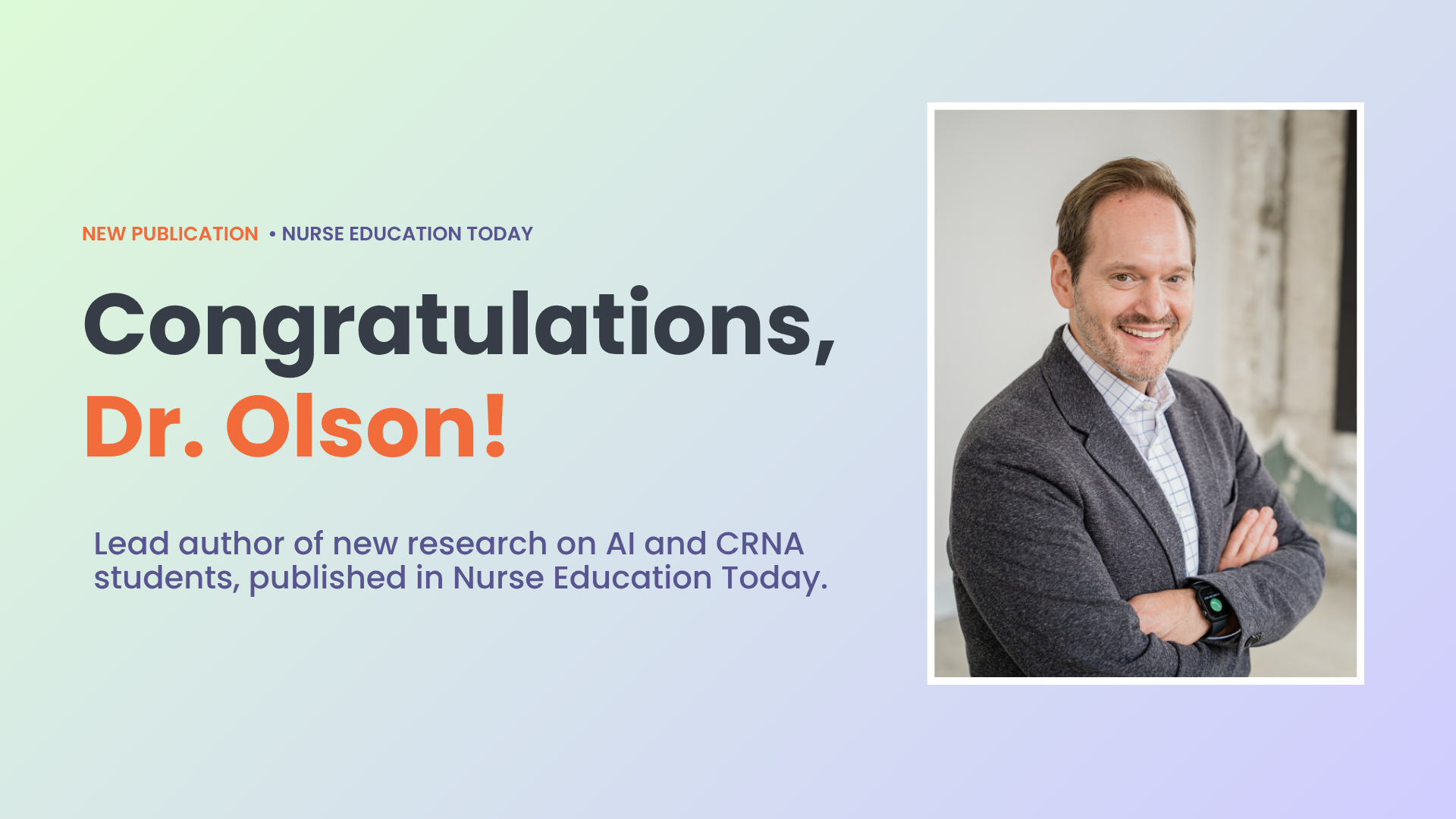
We have some exciting news to share, and a big congratulations to celebrate.
Dr. Joshua Olson, CRNA, program director, and co-founder of Ollivate, has just published new research in Nurse Education Today, one of the leading international journals in nursing education. As lead author, Dr. Olson and his co-authors examined a question that sits right at the intersection of anesthesia, education, and technology: how do future nurse anesthetists actually feel about artificial intelligence?
We could not be prouder. Here’s a look at the study, and why it matters.
About the Study
The paper, titled “Attitudes toward artificial intelligence among CRNA students: A multi-institutional cross-sectional study,” set out to understand how student registered nurse anesthetists (SRNAs) perceive AI in their education, specifically their familiarity with it, their perceptions of it, and their acceptance of AI-enhanced learning.
To do that, the team surveyed 401 SRNAs across six nurse anesthesia programs at universities throughout the United States, using the six-item Attitudes Toward Artificial Intelligence scale alongside demographic questions. The analysis followed rigorous methods, including non-parametric testing, Welch’s analysis of variance, and Benjamini-Hochberg correction for multiple comparisons, and the reporting followed STROBE guidelines for observational research.
In short: a large, multi-institutional, and methodologically careful look at a timely question.
What They Found
The results paint a clear and useful picture.
Overall, CRNA students reported limited exposure to AI and generally neutral attitudes toward it. The mean attitude score was 2.81 (standard deviation 0.81), which sits in the neutral range but just below the scale’s neutral midpoint of 3.0.
At the same time, a few areas stood out more positively:
• Positive feelings toward AI scored higher, at 3.14.
• Perceived usefulness of AI in coursework scored 3.11.
• Agreement that instructors should teach students how to integrate AI scored 3.08.
Notably, subgroup analyses by sex, race/ethnicity, age group, and study site revealed no differences that remained significant after correction for multiple comparisons, suggesting these attitudes are fairly consistent across student demographics.
Why It Matters
Here’s the part that makes this research especially important.
As AI tools become increasingly woven into anesthesia care, from preoperative risk stratification to intraoperative monitoring, the CRNAs of tomorrow will need to understand and work alongside these technologies. Yet CRNA students have been underrepresented in research on AI knowledge and attitudes, leaving a real gap in the literature.
This study helps fill that gap, and its conclusion is both clear and actionable: nurse anesthesia students show limited familiarity with AI and hold neutral perceptions and modest acceptance of its integration. That points to a concrete need for structured AI literacy education within CRNA programs, so students are prepared for the increasingly AI-enhanced clinical and academic environments they are entering.
In other words, the study doesn’t just describe where students are. It points to where nurse anesthesia education needs to go.
And because AI is changing so quickly, this is only a starting point. The team already plans to replicate the study, so that as the tools, training, and technology keep evolving, our understanding of how future CRNAs relate to AI keeps pace with the field.
A Proud Moment for the Ollivate Team
For all of us at Ollivate, this is a genuinely proud moment.
Dr. Olson has always brought a rare combination to the table: a working CRNA and program director who thinks deeply about how healthcare professionals learn. That same commitment to evidence-based, forward-looking education is at the heart of everything we build. Seeing him contribute to the field’s understanding of AI and nurse anesthesia education, as lead author in a respected journal no less, is exactly the kind of work we believe in.
Research like this makes the whole profession stronger, and it reflects the thoughtful, learner-centered approach that drives our team every day.
Congratulations, Dr. Olson!
So from the entire Ollivate team: congratulations, Dr. Olson, to you and your co-authors on this achievement. Thank you for advancing the conversation about how we prepare the next generation of nurse anesthetists for a rapidly changing world. We can’t wait to see what’s next.
Read the Study
Olson J, Travo A, Olla P, Campbell YN, Diaz VJ, Davis R, et al. Attitudes toward artificial intelligence among CRNA students: A multi-institutional cross-sectional study. Nurse Education Today. 2026; article 107437. doi:10.1016/j.nedt.2026.107437. Read it on ScienceDirect.
