Types of Nursing Degrees: 6 Different Degree Levels to Know
Explore six nursing degree levels, from LPN to DNP, and learn which path best prepares you for advanced practice roles like CRNA.
The nursing profession is as diverse as the people who choose it. Whether you’re just starting out or dreaming of becoming a Certified Registered Nurse Anesthetist (CRNA), understanding the different types of nursing degrees helps you plan your next move with confidence.
Each degree unlocks new opportunities; whether that means stepping into patient care as an RN, advancing to leadership, or specializing in anesthesia.
In this guide, we’ll break down six nursing degree levels, from entry-level to doctoral programs, and show how each one fits into your RN to CRNA education path.
Licensed Practical Nurse (LPN/LVN) Certificate
The LPN/LVN certificate typically takes 12–18 months to complete and teaches foundational skills in patient monitoring, wound care, and medication administration.
Career Outlook:
Entry-level roles in long-term care, clinics, and rehabilitation centers.
Quickest way to gain clinical experience and begin earning.
Ideal for those exploring healthcare before pursuing higher degrees.
Learn more:
Associate Degree in Nursing (ADN)
An Associate Degree in Nursing (ADN) is a two-year program that qualifies you to sit for the NCLEX-RN exam and practice as a Registered Nurse.
Why choose it:
Lower tuition than a BSN.
Fast entry into the workforce.
Can bridge into BSN or MSN programs later.
Read more:
Bachelor of Science in Nursing (BSN)
A BSN is often considered the modern standard for hospital-based RNs. This four-year degree deepens your knowledge of leadership, research, and evidence-based practice.
Benefits of a BSN:
Expands career options and salary potential.
Required for most graduate-level programs.
Builds a foundation for the pathway to becoming a CRNA.
Read more:
AACN: The Impact of Education on Nursing Practice
Master of Science in Nursing (MSN)
A Master of Science in Nursing (MSN) unlocks advanced practice roles — including Nurse Practitioner and many Nurse Educator roles.
Expands your career options to include leadership, clinical, and educational roles.
Strengthens your expertise in patient care through advanced science and evidence-based practice.
Positions you for higher earning potential and greater professional autonomy.
Learn more:
What Is the Value of a Master’s in Nursing?
Doctor of Nursing Practice (DNP)
A CRNA must hold a Doctor of Nursing Practice (DNP) or Doctor of Nurse Anesthesia Practice (DNAP) degree, as a master's is no longer sufficient.
Program Highlights:
3–4 years beyond the MSN.
Focus on systems leadership, quality improvement, and evidence-based practice.
Graduates are equipped for executive or independent roles.
Reference:
Becker’s Hospital Review — 5 CRNA licensing change questions, answered
PhD in Nursing
The PhD in Nursing focuses on research, education, and leadership. While not required for anesthesia practice, it’s ideal for nurses who want to shape healthcare policy or direct CRNA programs.
Career opportunities:
Nurse researcher
Academic faculty
Policy consultant or director
Reference:
National Institute of Nursing Research (NINR)
Grow your expertise through continuing education with Ollivate.
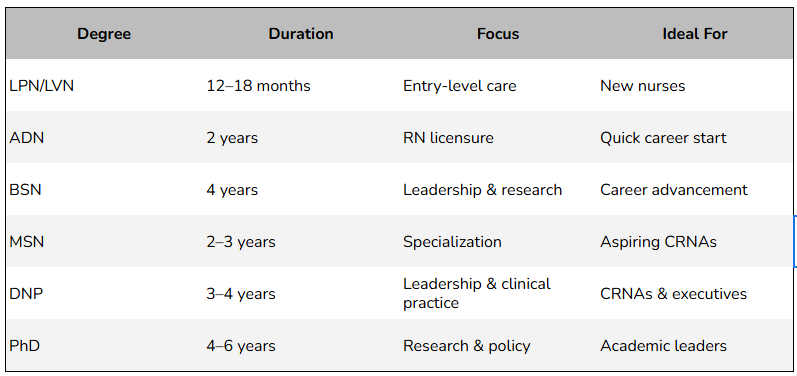
This table summarizes each nursing degree level, including program length, educational focus, and who the degree is best suited for. It offers a quick overview to help RNs determine which degree supports their long-term goals, including the path to becoming a CRNA.
From RN to CRNA — Mapping Your Journey
Here’s a quick roadmap for RNs who want to advance into anesthesia:
Gain 1–3 years of ICU or critical care experience.
Complete GRE or CCRN requirements.
Apply to an accredited DNP Nurse Anesthesia Program.
Pass the National Certification Exam (NCE).
Ollivate supports you every step of the way—from SRNA coursework to certification.
Conclusion
No matter where you start, each degree brings you closer to a fulfilling nursing career. From bedside care to anesthesia practice, every step matters.
At Ollivate, we’re here to help you grow with evidence-based CRNA prep, continuing education, and mentorship designed for SRNAs and CRNAs.
✨ Your nursing journey deserves support—start strong with Ollivate’s learning tools